

Throughput’s economic links already provide a meaningful attraction for zones to one another—it’s like the bonding of atoms. The interdependency naturally calls the zones into proximity. But for the system to have real “chemistry,” what’s immediately evidently missing is a repulsive force.
In other city games, this is traditionally accomplished with a notion of “pollution”—dirty industrial zones produce a repulsive externality. But Throughput is a world of abstractions, and the physicality of real pollution is incongruent.
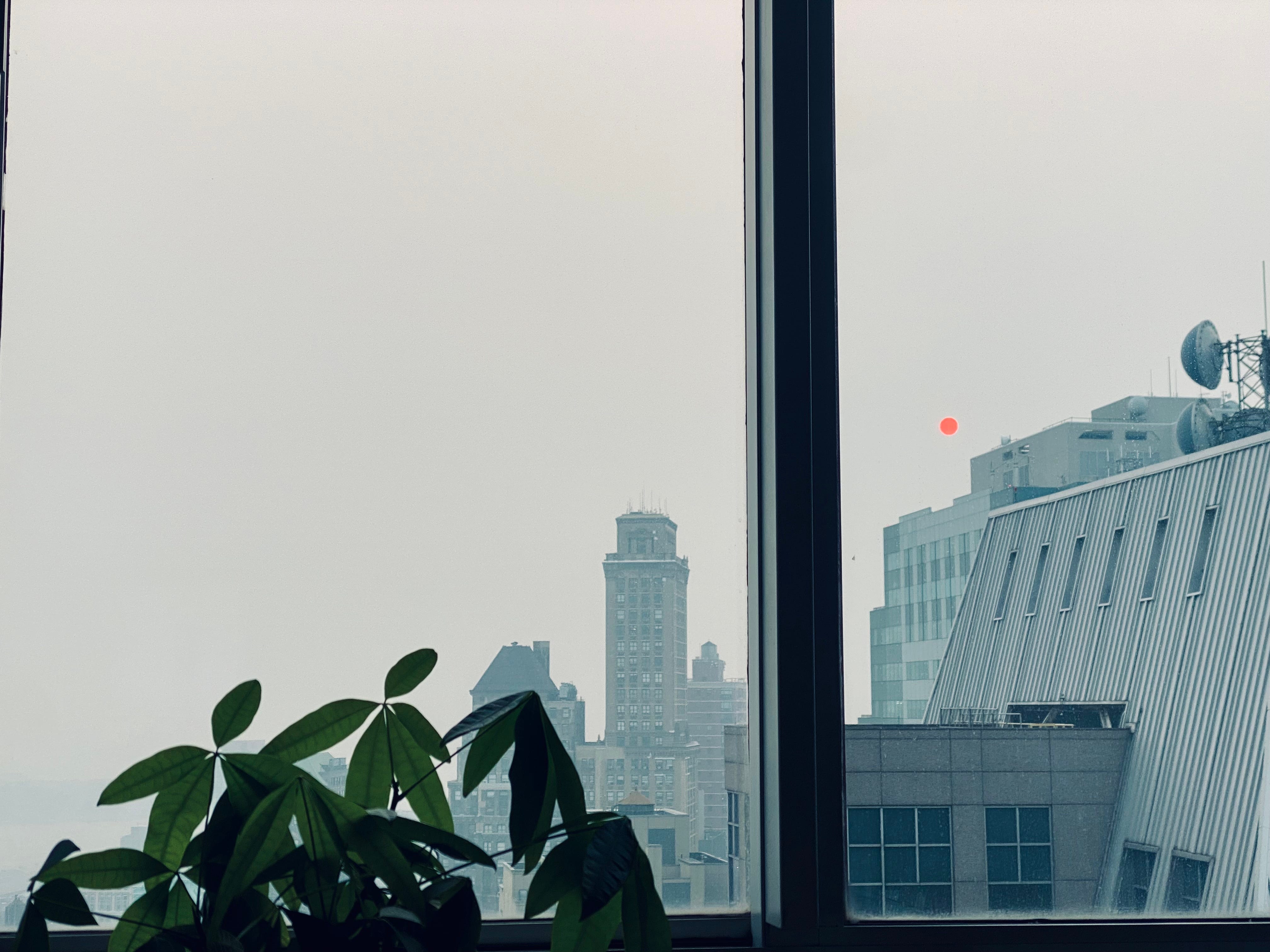
I knew what I wanted to name it instead when I was watching somebody play SimCity 3000. While SimCity 3000 did have pollution, you’ll find you must also curate your city’s aura.
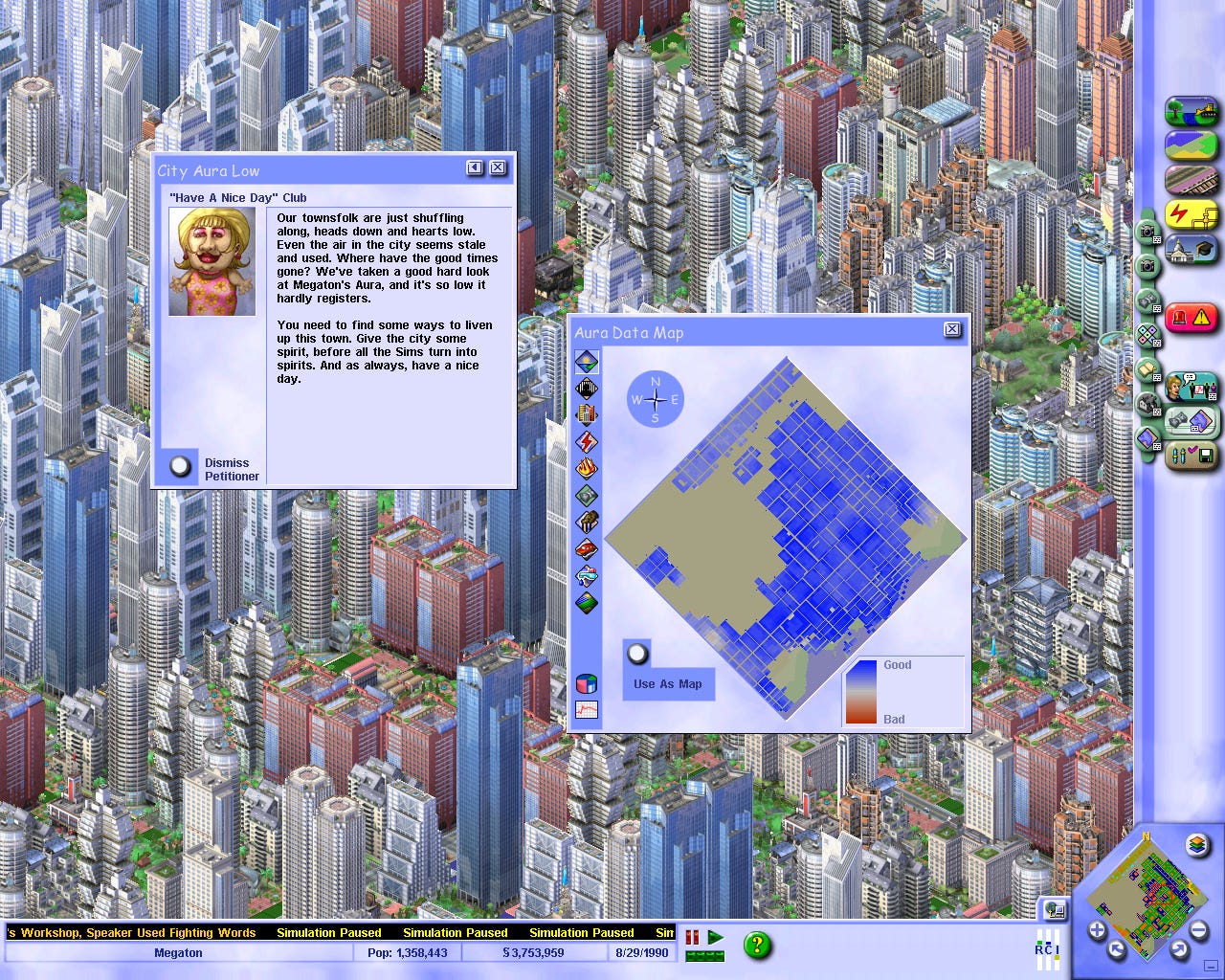
The heady nature of the term made it a perfect fit Throughput—the city inside your head. Thus Throughput’s notion of “Pollution” became “negative aura.”
This of course begs the question—what then, is Throughput’s notion of “positive aura?” SimCity 3000 used landmark buildings, as well as smaller constructions such a parks, as a way to represent the “land value”-like ideas in a city simulator. Still, I think this system doesn’t quite hit the mark.
Consider a human-scale situation you’ve likely noticed. As carefully curated as the “vibes” might be in a living room at a house party, where is the space most alive? Where does everyone actually gather? In the kitchen. Why? Because everybody has an excuse to be there.
In this 2001 interview with Jane Jacobs (author of The Death and Life of Great American Cities), Jacobs mentions a similar situation: “New Urbanists want to have lively centers in the places that they develop, where people run into each other doing errands and that sort of thing.“ But, she notes, carefully curated third spaces placed like “shopping centers” miss the point of connection. The point of connection lies at the crossroad.
In the real world, there’s more depth to vibe curation than just plopping down parks and plazas. The attractiveness of a space isn’t just about its standalone aesthetics, but perhaps in majority about its functional properties. It’s in that depth we can glimpse an eternally fresh gameplay challenge.
So how are we to compute positive aura? It isn’t just crowding and traffic that we want to look at, that is decidedly already negative aura. Instead, we’ll look at the diversity (perhaps you could call it entropy) of the traffic in the area.
An edge carrying 40 units of one resource? High usage, one type, pure negative aura. That’s a highway. Dead. A crossroads where goods, commuters, and education all intersect? Moderate usage, high diversity: positive aura outweighs the traffic term. That’s a town square. Alive.
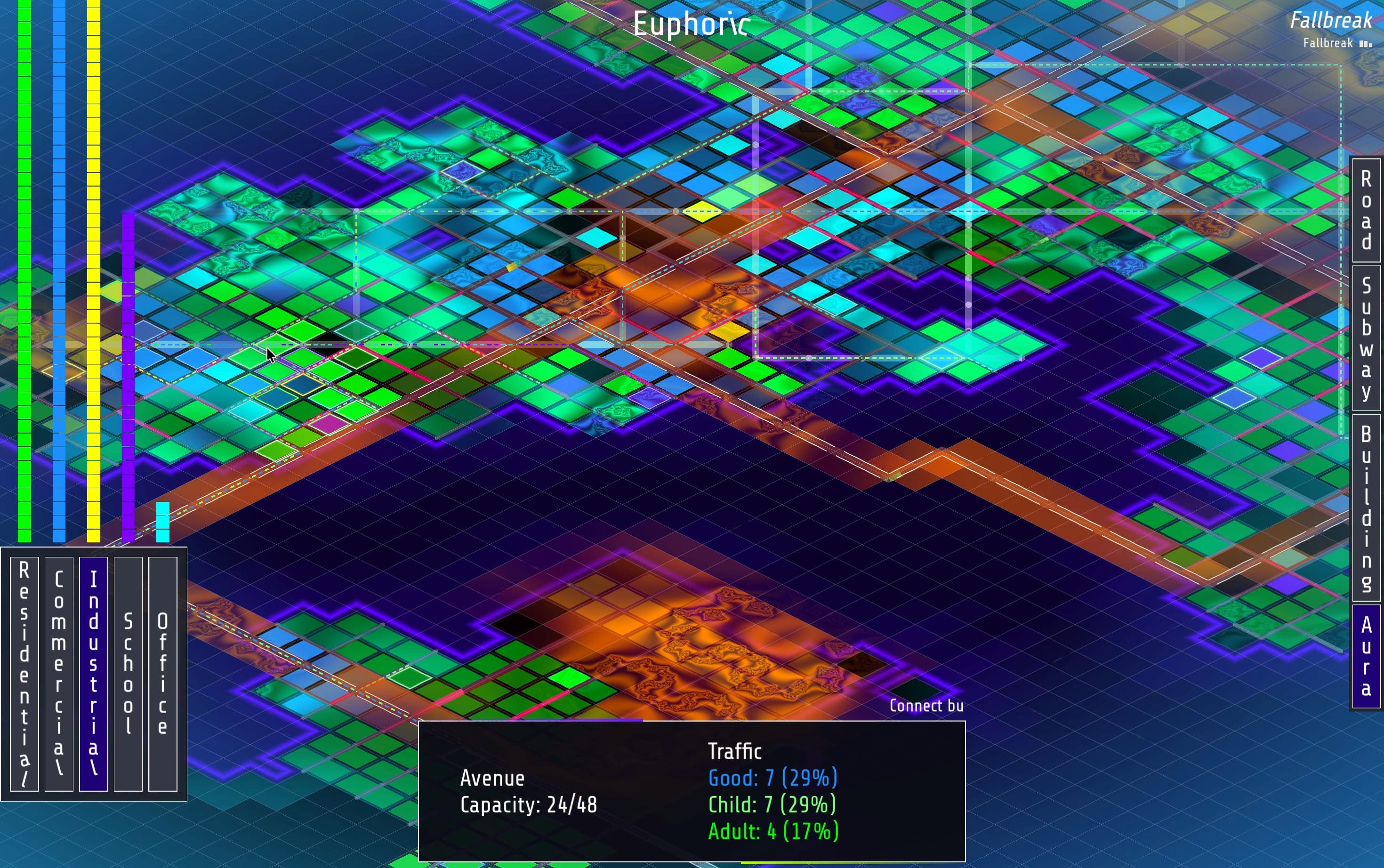
What remains is how to best represent this death and life visually. Typically, pollution is represented in orange or gray overlays. But there’s an aspect of what it does missing from that representation—it is a chokepoint, a bog, an ensnarement. I wanted it to be convoluted—which is how I arrived at using a Julia fractal as an aspect of the overlay.
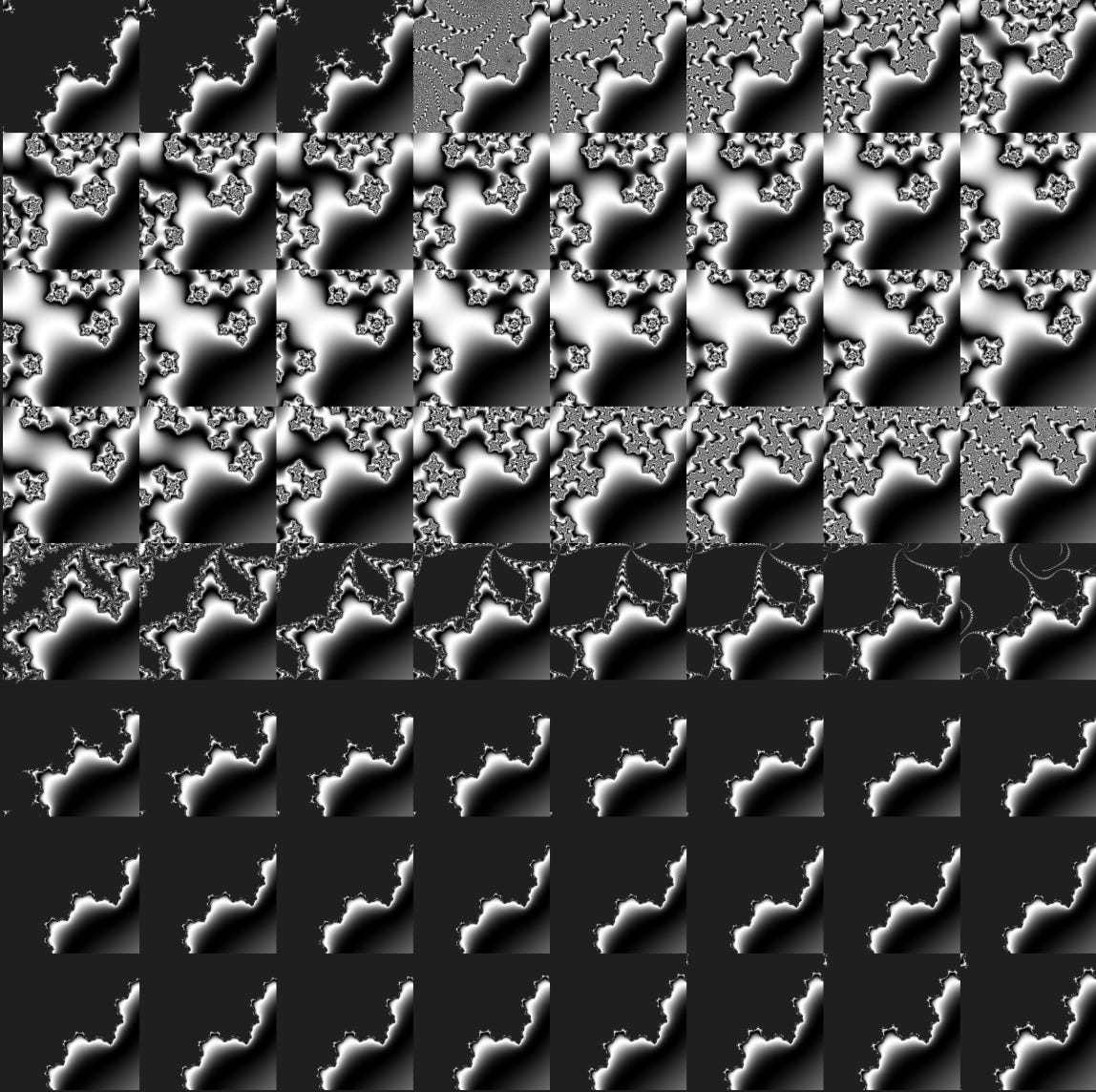
To enhance the plain orange, I baked the Julia fractal into a “flipbook” of images loaded into GPU memory, tiled, and overlaid isometrically. The fractal flipbook itself was rendered in black and white—the aura shader then interpolates color alpha based on aura value how much of the fractal would actually show through in red and orange.
When it came time to add positive aura, it followed naturally: I simply needed to give the overlay a tint in the positive direction in a contrasting cyan, and suddenly the entanglements shift to wispy nebulas. Two sides of the same thing.
I don’t know if the universe can be split into good and evil, but I think there’s plenty of evidence it can be split into attraction and repulsion, buildup and decay. As tempting as it is to search for value in only one of those states, one can’t exist without the other. Instead what we can find is that both can be beautiful.