

We’re going to have to talk about genre.
And genre is an intimidating topic to talk about. On the one hand it can bring out the most rigid and persnickety in us, such that on the other hand it almost seems necessary to throw up our hands and deem it reductive. But failure to describe begets failure to have the thought entirely, so is not outright anti-intellectual to reject categorization—reject naming things?
Unfortunately for you all I’m an Engineer, so I reduce intellectualism to practicality. And there’s two primary benefits I see to pushing forward on conversations about genre:
Discerning what makes a piece work. As an artist, it’s useful to deconstruct and seek commonalities. It’s the equivalent of taking apart an electronic device to see how it works and putting it back together again.
Distinguishing relevance and legibility: there’s such a thing as a piece that is too original. While an artist may have esoteric ideas, a piece of work that is too far removed from existing work is doomed never to be understood—even by the artist, the art forever stuck as a vague idea.
As an exploratory example, let’s examine the path to possibly one of the most acoustically gobsmacking moment in music history: the journey of the artist Sonny Moore, a.k.a. Skrillex. His debut EP Scary Monsters and Nice Sprites (as the name suggests, a love letter to the call-and-response composition method) was explosive material back in 2010. It was a total maximalist subversion of Dubstep, a surprisingly minimal genre at its core. So much so, that “UK Dubstep” and “American Dubstep” (or “Brostep”) are now often considered separate genres.
But Moore’s musical journey didn’t begin with the Skrillex project. He had previously done vocals for a “Screamo” band called From First to Last, which combines influences from the Emo and Metal genres. He learned sound design with the influence of Noisia, who primarily worked within the Drum and Bass genre (arguably Brostep’s closest relative).
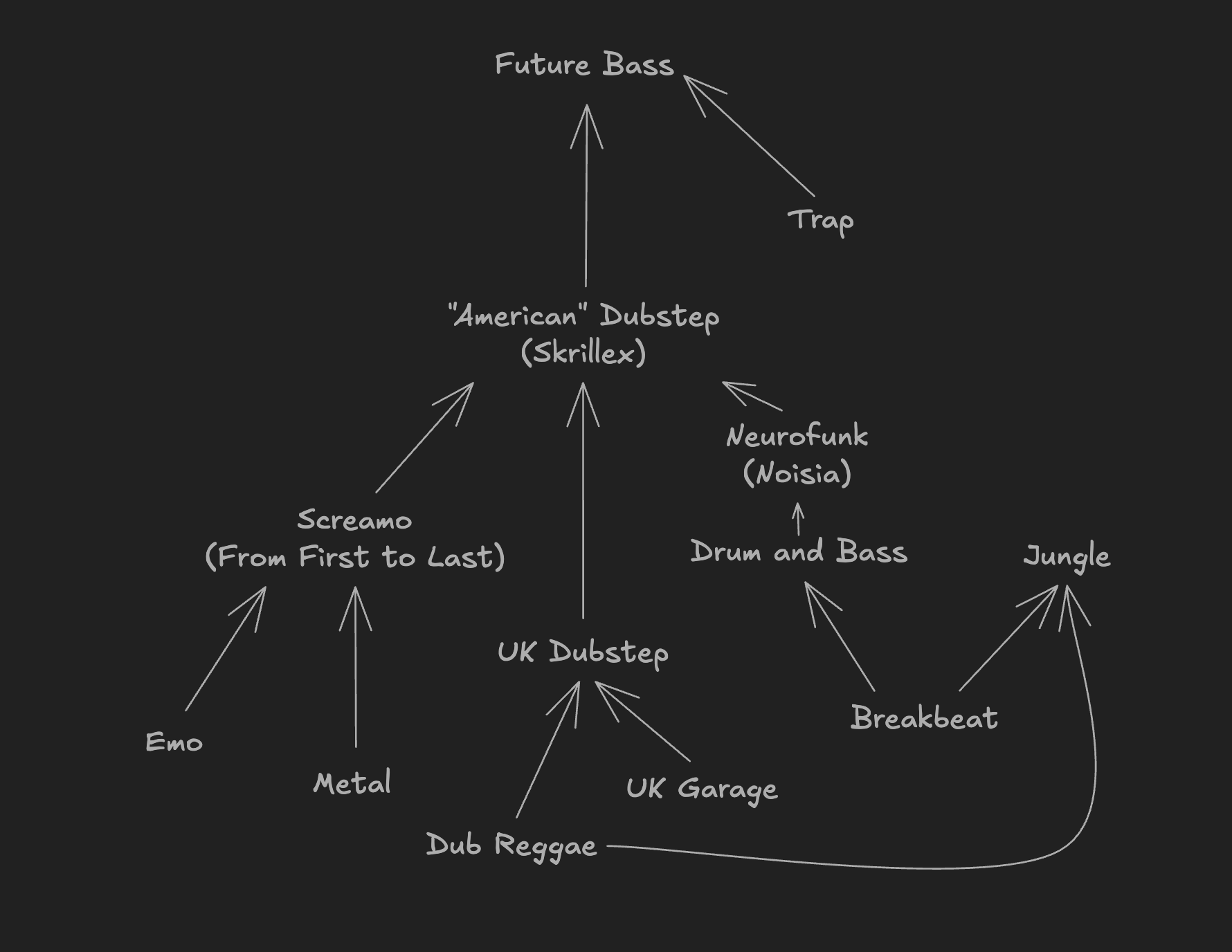
It’s worth noting the crescendo of Skrillex’s artistic arc didn’t culminate until a year later, when he reached for even more estranged rock influences to create what in my opinion will go down as one of the greatest works of the 21st century: Breakin’ a Sweat, the track he created with The Doors, topped off with an ancient clip of Jim Morrison himself predicting Skrillex’s existence.

There’s a lot of information apparent in this graph alone, and it roughly mirrors the way Jim Morrison is thinking about it—as a progressive branch and merge, an evolution.
American Dubstep was a massive distillation of many genres that came before it. One might expect that to mark the beginnings of a Cambrian explosion—instead, it was more like an extinction event. Its legacy mostly consists of works that, while often good, are nonetheless self-referential.
The best-fitting model to describe what’s happened here is a Thomas Kuhn paradigm shift: wherein a revolutionary idea is born from pushing up against the boundaries of the current ways of thinking—once the revolution happens, we begin again to explore the current New Idea to its fullest potential. I think this ultimately is a good signal for American-style Dubstep: that it feels fully-explored doesn’t mean it’s done with, it means it’s ready for another subversion.
The conclusion itself is perhaps less fascinating than the structures that let us derive it. Structurally, genre information is typically stored as a tag system. A given song is tagged with, e.g. Electronica. There’s circumstances where tag systems are really powerful—it’s often the better way to structure a filesystem when everything is indexable on a pivot. But there’s another way to organize files that has proven incredibly effective for tracking complex, continuously updating work, and that’s git—structured as a Directed Acyclic Graph like the one above.
What about the second use case, distinguishing relevance? Tag systems can do pretty well at recommendation, especially when extended to multi-tag or subcategorical systems. But from the venn diagram illustration below, we can see we easily lose a lot of relevant information to the conversation we just had above.
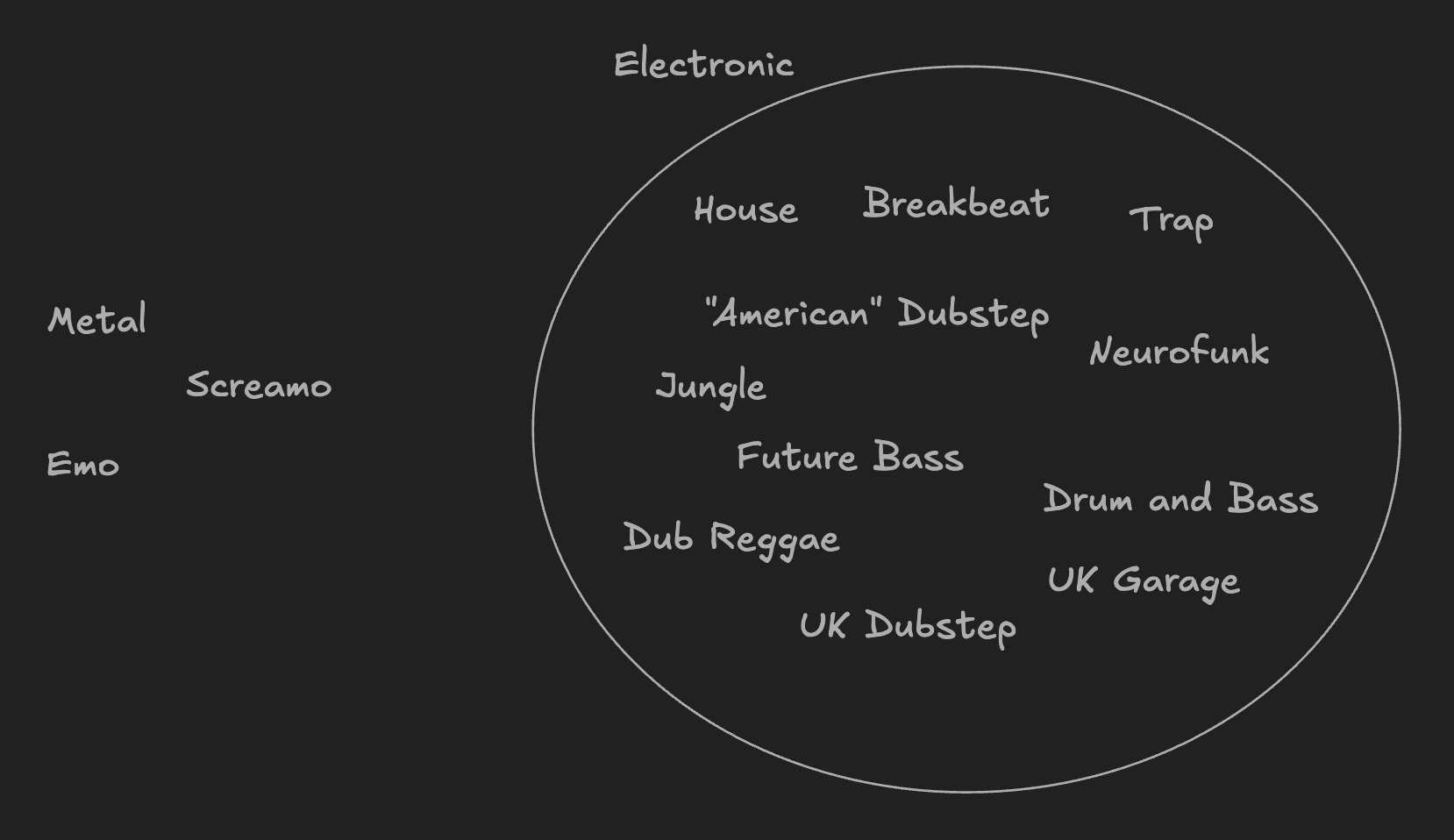
You’ll notice that, while we can put a good chunk of Skrillex’s influences under the “Electronic” category, we lose all association with his previous Rock-adjacent roots. An American Dubstep enjoyer might very easily get more out of the Metal category than they would out of UK Garage—or anything House-adjacent. In fact, although not officially categorized yet, I think that’s the new paradigm the music of the 2020s is ramping up to explore.
Category graphs an be as granular as necessary—so granular, in fact, that the categorization can be at the level of an individual work. We can define not by the node but its edges—making the categorization so implicit that it practically melts away completely. This is fundamentally different from an outright refusal to categorize: with this—yet another model that ends up subverting what it intended to grasp—we end up with decidedly useful lines of pursuit to aid in understanding our own creation.