

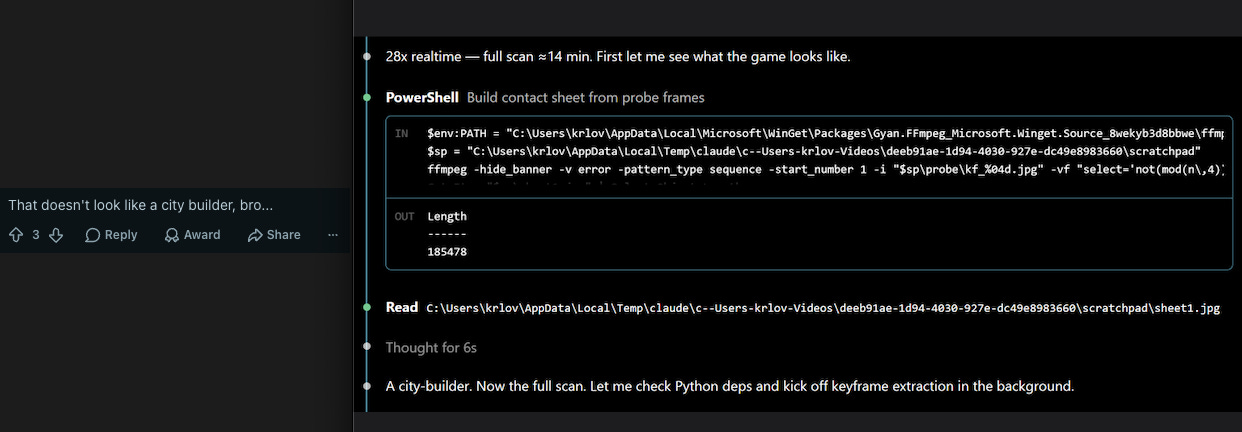
Most citybuilders, including my own, are based on the Residential / Commercial / Industrial zoning trifecta. Commercial in particular consists of blocks of storefronts. But to me that seems like a holdover from the 90s; a huge point of contention in this new millennium has been the downfall of such retail establishments, and the rise of online delivery.
A modern citybuilder, then, would take these changes into account. I’m been critical of simulations too focused on realism, so I feel the need to clarify my position: my work is not uninformed by the real; rather, I aim to portray the essence of the real, and then push beyond it.
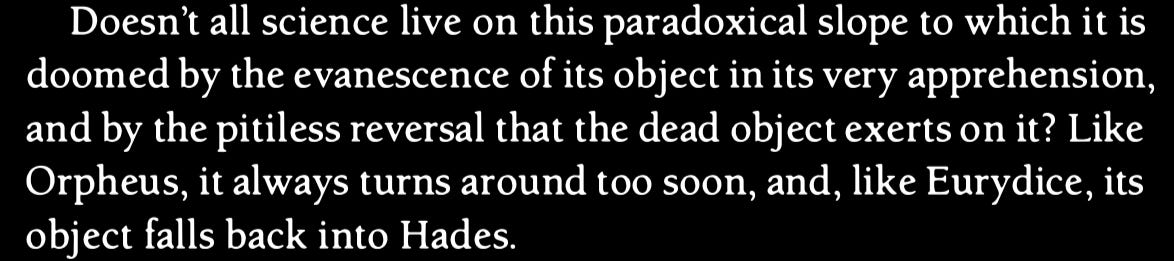
In Simulacra and Simulation, Baudrillard describes how an image drifts from whatever it depicts, in four stages. First a faithful reflection of something real. Then it distorts that thing. Then it hides that the thing is already gone. And finally it drops the pretense entirely and refers to nothing but itself.

Watch the city sim storefront do exactly this:
Reflection. A pixel drawing stands in for a real shop—a flea market, boutique, a place with a door you’d walk through.
Distortion. Flattened to a blue zoning square. Still gesturing at retail, but now it’s an abstraction.
The absence. The warehouse. There’s no storefront here at all; it’s a logistics node keeping up the fiction that “shopping” still happens somewhere you could point to. The Amazon storefront masks the fact that the shop is gone.
Pure simulacrum. And then Throughput, where the thing on screen isn’t a store, or even a stand-in for one—it’s a congestion value, an aura score, a number that only means other numbers. A sign referring to nothing but the system that produced it.
What is the essence of the modern American city? It’s a hyper-efficient one, even while over-reliant on infrastructural retrofit. And even from an environmental justice standpoint, delivery is generally the more eco-efficient mechanism for suburbs in terms of distance traveled; it’s like a bus for groceries—not to mention a lifesaver for the disabled. What justice-minded urbanist doesn’t like buses?
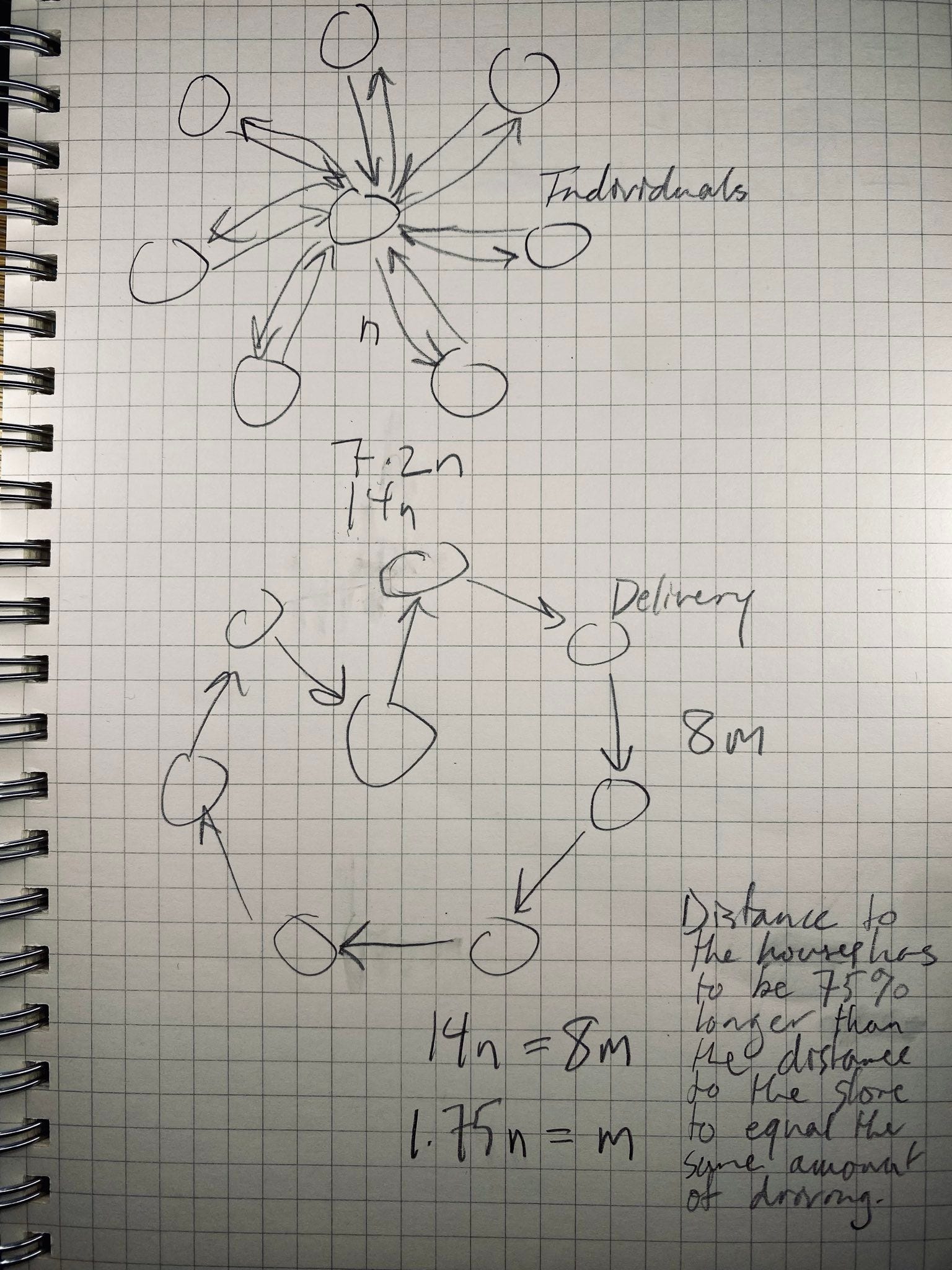
Like in most systems, the tradeoff isn’t best portrayed strictly but governed by a function: because individuals make a full trip to the store and back, distances to the houses in a neighborhood have to be much longer than the distance to the store to equal the same amount of driving. In just a chain of 7, the distance has to be 75% longer.
Of course, critics of the Amazon model highlight quite a few advantages to keeping smaller retail around—mainly based on positive externalities: more jobs and growth spurred by greater desirability. Which is why the diverse in traffic retail brings in Throughput is your best bet to induce positive aura.
These insights inform how we’ll design the introduction of warehouses into Throughput—gigantic, towering industrial quadrangles emitting strong negative aura, they’ll serve a whopping 48 demand for Goods upgraded with just a bit of labor power and software.
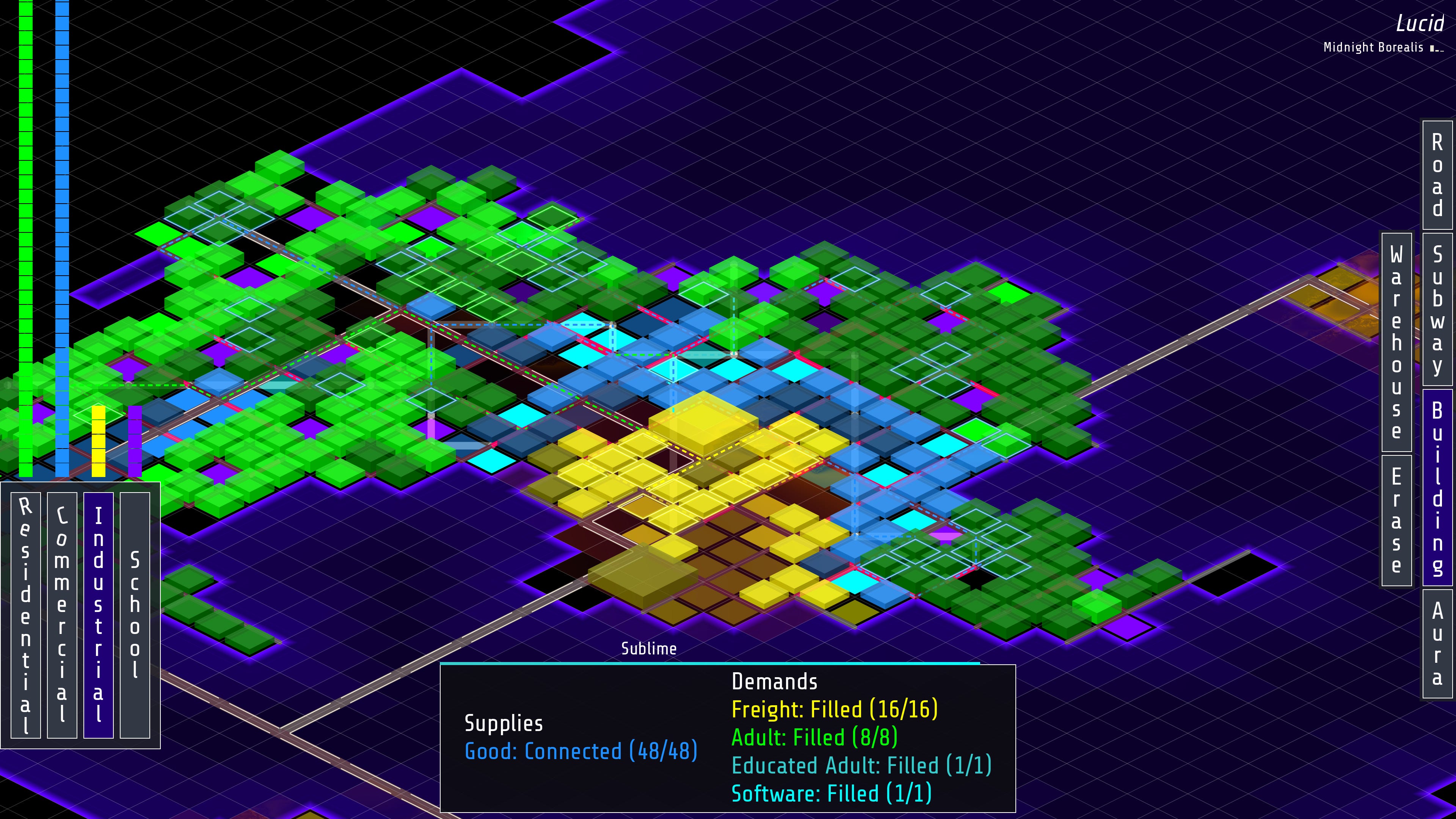
But warehouses in Throughput have another advantage. Instead of the normal there-and-back routing, they’ll deliver loads of 8 goods in a sequential tour. This means more demand served on less congested roads, a massive immediate boon for your throughput bottom line.
This poses an unique algorithmic challenge. Optimal shortest path routing for one pair is a polynomial algorithm. When you add stops on a tour, suddenly you’re dealing with combinatorics—and the number of stop sequences grows factorially. Solving this problem optimally has no known polynomial algorithm—we’re dealing with an NP-hard problem.
This problem is so vast that my friend Scott Czepiel turned it into a human competitive game unto itself. The problem is also very much based in our reality—tools such as UPS Orion devote tremendous computing time to solving this very problem. And in it doing so we witness the map going beyond the territory to then precede it.
To add to that, there’s a couple of requirements that render Throughput’s version hyperreal. We have the “luxury” of choosing our optimal targets—which isn’t really much of a luxury at all, adding another dimension of algorithmic combinations. We also have a very serious time constraint: whereas UPS Orion solves routes once a day, we need to solve our routing in time for our 4-bar tick.
This is when performing clean engineering means getting dirty. We’re going to use our constraints to turn an intractable problem tractable. Building on the diagram from earlier: because Throughput abstracts the time element, we’ll see the benefit not in driving time but in congestion: a fanout would dump all 8 loads onto the depot’s edges simultaneously, whereas a tour spreads them apart. A chain of 8 means that even if our paths are 75% longer, we’ll still see a decrease in overall congestion—our paths can be quite suboptimal and we’ll still see an overall win.
To choose candidates for the route, we’ll use our existing Dijkstra machinery—that make one aspect to near-linear. Then we’ll use nearest-neighbor to choose the route. Nearest-neighbor runs are about 25% longer, so it spends part of that margin. Our greedy route still beats individual trips as long as the optimal tour's legs come in under ~40% over the store distance (the optimal route is the denominator, 1.75 / 1.25 = 1.4).
When I benchmarked the boundary match, it increased from 33 ms to 205 ms—which I don’t mind, I’ve been looking for ways to use the headroom C++ bought me. But upon closer inspection I found that it wasn’t the delivery routing itself that caused the increase in time—a clean A/B test showed the new routing only added 3 ms.
The increased time was actually due to the wider searches caused by less congestion. The win on delivery routing is also topological: we see a significant decrease in congestion around the warehouse itself, which is why I’ve also chosen to use delivery routing for schools.
So we’ve shown empirically that warehouse delivery reduces congestion. So what? What about negative externalities? What about the reduced jobs? What about close-proximity hub-and-spoke models? What about the vibes?
That's the balance Throughput hands you. And here's the part Baudrillard would insist on reiterating: there's no authentic city underneath waiting to be recovered. He hated The Matrix for staging a real world you could wake up to.
Reloaded reveals Zion as a release valve, a rebellion the system builds for itself, torn down and rebuilt every cycle. Baudrillard also critiques this as deferring to a “pseudo-freudian” authority in The Architect, turning the allegory Platonic. But I disagree with him—The Architect is jungian. Neo as ego, Trinity as anima, Smith as Shadow. This means that The Architect is You; the binding super-ego authority of your own psyche.
It's a shame the film itself flinched, and reached for a redemptive Hollywood ending. The better cut would’ve been a Greek tragedy: a hero who discovers his revolt was scripted from the start, while the machine god born of his own psyche grinds on, indifferent.
Throughput doesn’t offer you a Zion. There’s nothing outside You to escape to—you’re the Architect here. That perfectly optimized city, humming and decongested and hollow, isn’t a fate the game hands you. It’s what your own drive to optimize builds. The machine god is yours.
Welcome to the desert of the real.