

As gamers, we’ve had extraordinary access to incredible graphics power for decades now. Primarily, this graphics power has been used in the pursuit of hyperrealism. While this is a worthwhile pursuit, I think it’s a rather oversaturated one. Today in conclusion, I’m citing this as the primary reason I chose to develop a fisheye lens, despite its very valid inspiration from Homestar Runner. I’m pursuing the question: what else can we do creatively with this extraordinary graphics power every gamer has in their PC?
The best sci-fi development inspiration comes from books, and one of my all-time favorites is the Murderbot Diaries series. The series follows the internal life of a human-bot construct designed to the narrow specifications of being extremely well suited to security roles. This book series is now a “serial” on Apple TV. Watching it, I was struck by how TV as a medium can’t translate the internal perceptive that makes Murderbot—as not a quite a human, not quite a bot—such an interesting construct.
It’s shown that Murderbot always looks slightly to the side of the head of anyone its talking to. What is not shown: typically in conversation Murderbot is not looking through its eyes at all. Given that it is security-specialized, it integrates whatever cameras are in its vicinity straight into in own perspective, and whenever possible, it will choose to look through the cameras to observe its own conversation. This sounds dissociative, but given how cameras might as well be its own body, it’s really not. (Cyberpunk 2077’s netrunner mechanics do a pretty decent job at depicting this, though I get the feeling it could be explored more deeply—and pushed further.)
But what causes Murderbot to be so uncomfortable looking at people head on in the first place? What might the difference in perspective be? Here’s where we tie it back to my fisheye lens, and how we might be able to replicate the perspective described in the book through environmental storytelling in gaming.
Fisheye lenses might offer a security bot—in its main camera from which it aims weapons—a tactical advantage. They widen the field of view past what is normal from a human perspective, and provide extra detail within the closer, narrower field. It might be great for first person shooter mechanics. It also is less specialized—and could provide some weird dynamics—interpersonally. You can see it back in Missy Elliot’s video, which is clearly designed to be a little freaky. If every conversation felt as up close as this—wouldn’t that make you uncomfortable?

Anyway, to truly test if this dynamic works, I need to create a shooter prototype running through my fisheye lens. I’d test 1) if you can shoot accurately, and 2) if I can leverage the lens to add some exaggerative flair to a close-up situation.
Thus, I created the game Barrels in a Fish. While you yourself are trapped in a barrel-shaped environment, barrels fall increasingly quickly from the sky. If you shoot the barrels, a myriad of random fish will explode out of them, gradually filling your view with close-ups of (dead) fish.
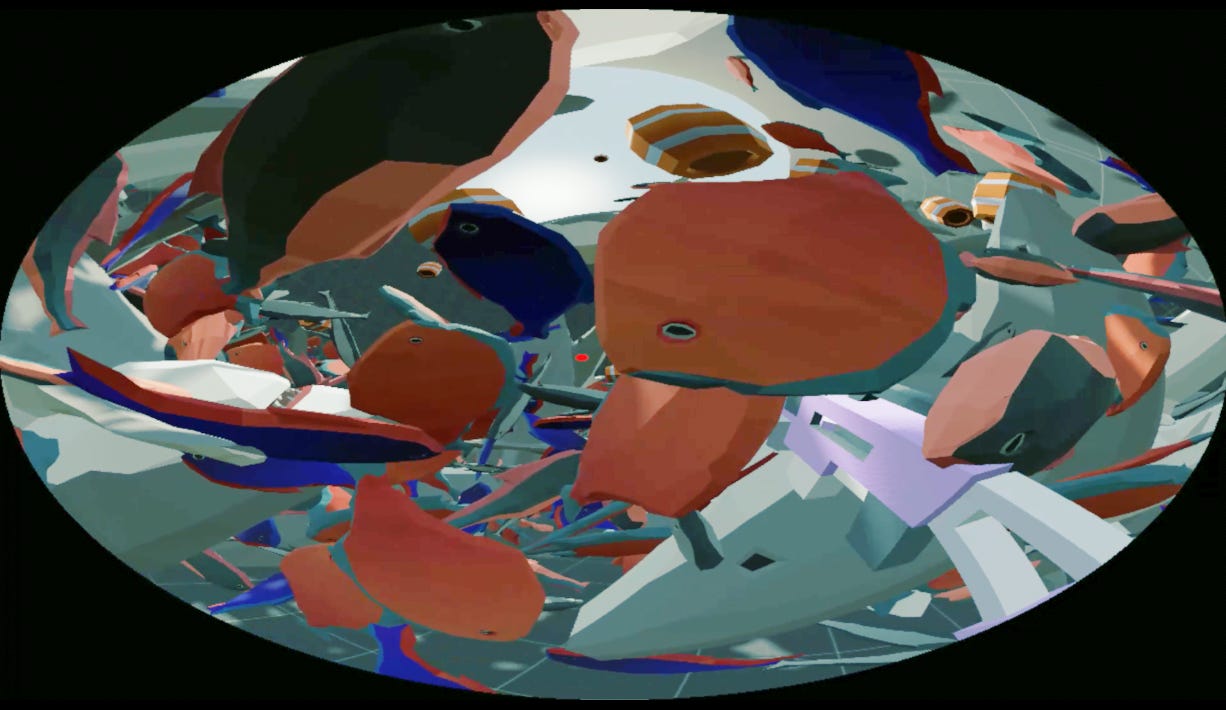
I managed to integrate my fisheye shader, cubemaps and all, with a godot game via cpp extension, which is pretty neat. The extension itself ended up significantly simpler than building it from scratch in vulkan was, although getting it to compile to wasm correctly—enabling it to be playable on web—involved a bit of trial and error.
I think the game yielded positive results for my hypotheses: I can still shoot accurately, and the lens made what was already an amusingly weird mechanic that much more impactful.
It also nicely closes a loop from the lens’ originally cited inspiration—we answer the question posed by Homestar: what happens if you point it at a real fish eye?